
HWA It’s Here

HWA It’s Here

What is HWA — and why it’s a threat
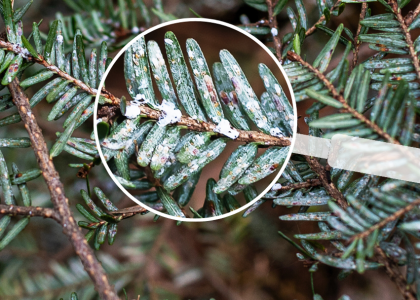
The Hemlock Woolly Adelgid (HWA) is a tiny, aphid-like insect (latin name Adelges tsugae) that infests Eastern Hemlock (and a few related hemlocks). It draws sap from nutrient and water-storage cells at the base of hemlock needles — gradually weakening the
Read More
Celebrating Our Supporters: 4th Annual Appreciation Gathering

Celebrating Our Supporters: 4th Annual Appreciation Gathering

On Sunday, September 7th supporters of Long Point Basin Land Trust gathered at Long Point Eco-Adventures in the Forestview Pavilion for the 4th Annual Supporter Appreciation Gathering. Guests included volunteers, donors, local community leaders, and Haldimand-Norfolk MPP Bobbi Ann Brady. MPP Brady brought greetings from the Province, and Executive Director […]

Read More

Golden-crowned Kinglet

Golden-crowned Kinglets (Regulus satrapa) are tiny, migratory songbirds in the kinglet family (Regulidae), a small bird family with only 2 genera, distributed across the Holarctic – Europe, Asia, and North America. Though small, it is a remarkably hardy species, enduring colder climates than

Read More

White-breasted Nuthatch

Description and Ecology ​
The White-breasted Nuthatch (Sitta carolinensis) is a small, agile songbird in the Nuthatch (Sittidae) family, distributed across

Read More

Tufted Titmouse

Description and Ecology 
The Tufted Titmouse (Baeolophus bicolor) is a small (~15 cm), vocal songbird in the Paridae family, a songbird family primarily of the Northern Hemisphere, which also includes chickadees and other titmice. It is one of five North American titmouse species, but this only one commonly found in

Read More

Blue-Grey Gnatcatcher

The Blue-Grey Gnatcatcher (Polioptila caerulea) is a tiny (10 cm), active songbird in the Polioptilidae family, a family found throughout much of North and Central America, closely related to the Wrens (Troglodytidae). It is the most widespread member of its genus, distributed throughout North America from southwestern Ontario to Florida,

Read More

Carolina Wren

Description and Ecology 
The Carolina Wren (Thryothorus ludovicianus) is a small (13 cm) songbird in the wren family (Troglodytidae), which is found exclusively in the Americas. Despite it’s small size, the Carolina Wren is the largest wren species commonly found in North America. Other wrens occurring in the Great Lakes Region

Read More

Brown Thrasher

Description and Ecology 
The Brown Thrasher (Toxostoma rufum) is a long-tailed, ground-foraging songbird in the Mimic Thrush (Mimidae family), which is exclusively American. Northern Mockingbirds (Mimus polyglottos) and Gray Catbirds (Dumetella carolinensis) are the other native species in this bird family occurring in the Great Lakes Region. It is the only Toxostoma species commonly

Read More

Red-winged Blackbird

Description and ecology 
Red-winged Blackbirds (Agelaius phoeniceus) is a large migratory songbird (~20 cm). It is a member of the American Blackbird Family, Icteridae. It is the most widely distributed species in the Agelaius genus, being found all throughout North America from the tropical Yucatan Peninsula to the subarctic Canadian boreal forest.

Read More