GOALS OF THE LONG POINT BASIN LAND TRUST
The Long Point Basin Land Trust works to establish and maintain areas or features of ecological interest and cultural heritage.
The Long Point Basin Land Trust promotes the conservation and preservation of the landscape, habitats, ecosystems, wildlife, species at risk and cultural heritage.
The Long Point Basin Land Trust promotes education and scientific research and co-operates with other Canadian and international organizations doing the same work.
WHAT IS A LAND TRUST
A Land Trust is a charitable, non-government organization dedicated to the long-term protection of important natural areas, native wildlife and ecosystems.
A Land Trust is supported by volunteers and offers an opportunity to be involved in the conservation of the local environment. Volunteers, representing a wide range of interests and expertise, provide the resources, energy, skills, community contacts and commitment necessary for the work of the Land Trust.
A Land Trust is a public policy tool that acts today to defend and entrench the rights of future generations that cannot, at present, defend their own interests to a healthy ecosystem.
HISTORY OF THE LONG POINT BASIN LAND TRUST
Incorporated in 1996 as a charitable organization, LPBLT is part of the growing LAND TRUST movement in Southern Ontario. LPBLT works with landowners or managers who wish to protect and preserve lands that have ecological, scenic, agricultural, historic or recreational qualities. LPBLT is one of the founding members of the Ontario Land Trust Alliance (OLTA), an organization dedicated to the creation and support of a professional and ethical Land Trust movement in Ontario. To this end OLTA has developed a code of Standards and Practices to guide the operations of Land Trusts. LPBLT has adopted these Standards and Practices to guide the operations of the trust.
THE LONG POINT BASIN LAND AREA
The geographical area in which LPBLT operates is part of what is referred to as Canada’s Carolinian region. This includes Norfolk, Haldimand, and Elgin Counties, as well as adjoining portions of Brant and Oxford Counties. All of the watersheds draining into Lake Erie from Kettle Creek east towards but not including the Grand River are considered in to be in the Long Point Basin area.
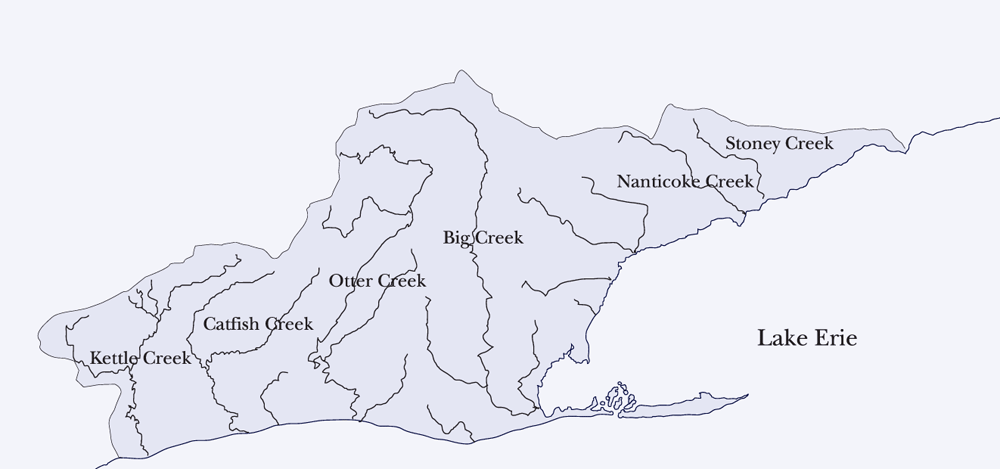
>Click on Image to Enlarge in Window
The Carolinian region is less than 1/4 of 1 percent of the whole country’s land mass and is home to more species than most other parts of Canada. Woodlands, savannas, prairies, wetlands found in this region are home to 2200 species of plants, 107 species of trees, 27 species of reptiles, 20 species of amphibians and 400 species of birds found here. Along with this rich biodiversity is also found 25 percent of Canada’s population that make their living working in the industrial centres and on the farms that compete for the habitat that all species need.

>Click on Image to Enlarge in Window
[The image above shows the working area of the Long Point Basin Land Trust overlayed on a map of remaining significant woodlands in Ontario. The map was prepared for The Big Picture 2002, based on an analysis jointly undertaken by the Nature Conservancy of Canada and the Natural Heritage Information Centre using satellite and background data analysis—green represents core areas of remaining significant woodlands (within 200m). The orange line indicates the approximate northern limit of the Carolinian Forest Zone in Canada.]
LANDSCAPE CHANGE IN SOUTHERN ONTARIO
In a 60 year period from 1861 to 1921 the forest cover of Carolinian Canada dropped from 77% to 19 % and 70% of southern Ontario wetlands were lost. Since then, there has been a slight recovery of forests in some parts of the area but overall the decline and degradation in natural habitats continue. This is why the work of LPBLT is important to restore and maintain the ecological integrity of the unique biodiversity found in this part of Canada.
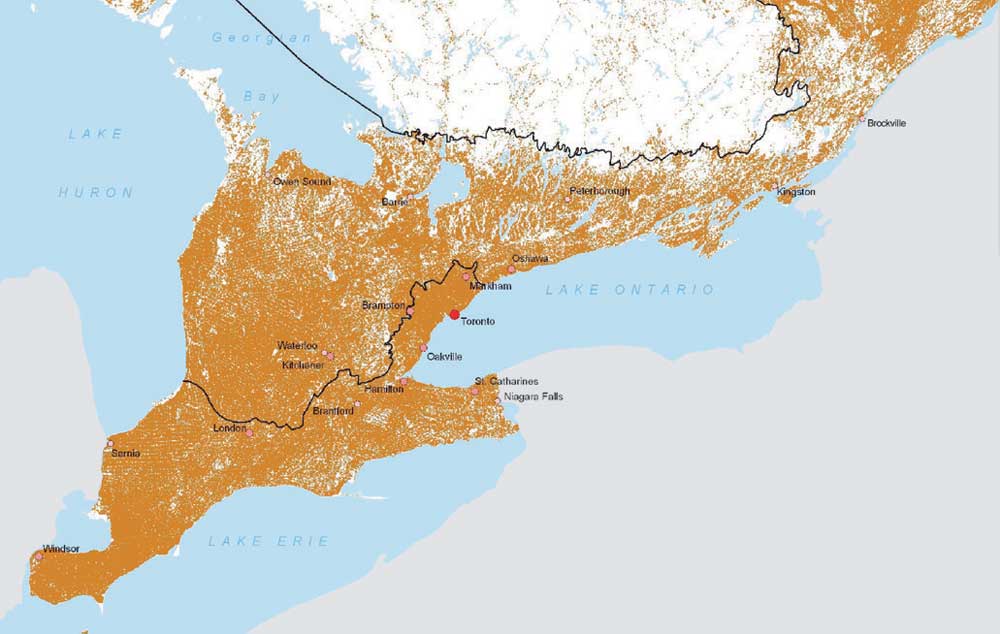
>Click on Image to Enlarge in Window
[The image above shows the distribution of converted natural areas in southern Ontario. The map was prepared for The Big Picture 2002, based on an analysis jointly undertaken by the Nature Conservancy of Canada and the Natural Heritage Information Centre using satellite and background data analysis.]
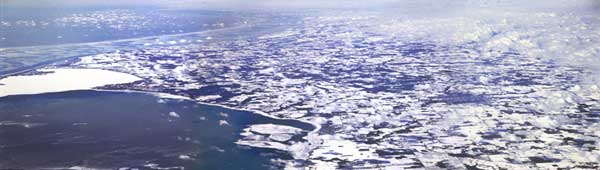
[Aerial photo of the Long Point Basin Land Trust Area. Dark patches show forested areas of Norfolk County. Photo: David Agro]